
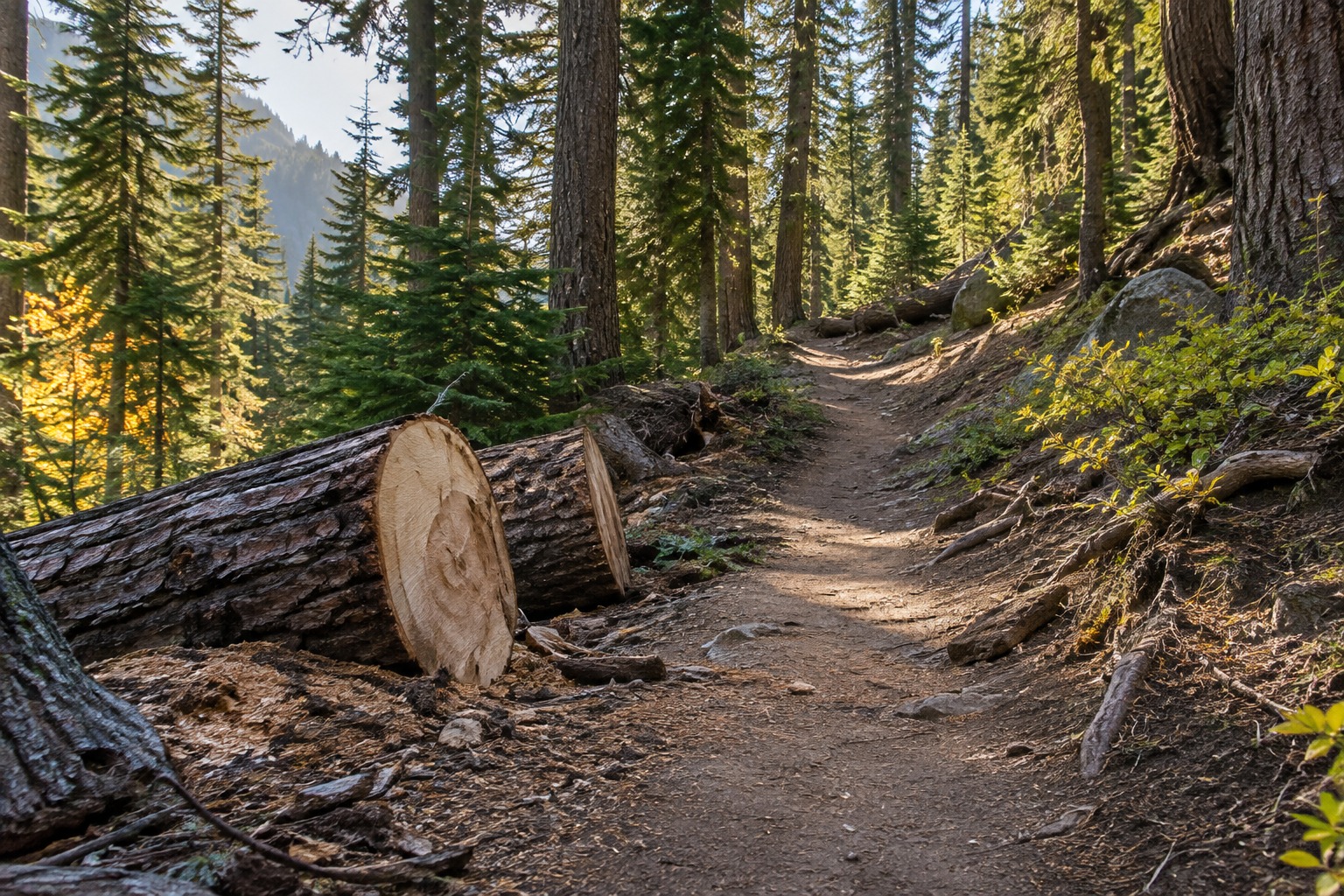
Most people spend their first season at a new job figuring out where the coffee is. The Mount Shasta Trails Crew spent theirs sawing through more than 250 fallen trees on the Pacific Crest Trail. Most of them had never done trail work before the season started.
- The new Mount Shasta Trails Crew cleared over 250 downed trees across about 75 miles of the Pacific Crest Trail this year.
- The PCT work centered on Sections O and P. The crew also logged out more than 25 additional miles of other trails.
- Traditional crosscut saws and hand tools worked alongside modern equipment all season.
A First Season Measured in Logs
The Mount Shasta Trails Crew is a new seasonal crew on the Shasta-Trinity National Forest. This year it worked the Pacific Crest Trail on the forest’s Mount Shasta and McCloud ranger districts and cleared over 250 downed trees across roughly 75 miles of the PCT.
That’s a big number for any crew. It’s even bigger when you remember that most of the people running the saws were new to this kind of work. Some of the logs had been lying across the trail for years, waiting for someone with the time, the tools and the patience to deal with them.
Most of the PCT effort went into Sections O and P. That’s the stretch running from Burney Falls through Castle Crags and then north toward Etna Summit. It’s a long piece of trail, and a lot of forest means a lot of trees that can end up across the path.
Help Near Bartle Gap and Miles Beyond the PCT
The crew didn’t work every mile alone. Near Bartle Gap, it teamed up with crews sponsored by the Pacific Crest Trail Association to finish five miles of brushing. Brushing means cutting back the plants and limbs that grow in from the sides of a trail. It doesn’t get noticed the way a giant downed log does, but it goes a long way toward keeping a path easy to follow.
The PCT was only part of the season. On top of those 75 PCT miles, the crew logged out more than 25 additional miles of other trails. It also did brushing and tread work across the unit. Tread is the walking surface of a trail, so tread work is the digging and shaping that keeps your boots on solid ground.
Put it all together and you get a crew that spent its first year doing a little bit of everything a trail needs.
Old Saws Still Have a Job to Do
A good share of the cutting happened the old way. Crew members used traditional crosscut saws and hand tools alongside modern equipment, so the season mixed new methods with very old ones.
The crosscut is still around for a practical reason. The Forest Service sees it as a skill worth keeping alive, especially in designated wilderness, where motorized equipment is generally prohibited. When a tree falls across a wilderness trail, a chainsaw usually isn’t an option. Someone has to know how to size up the log, set the cut and work the saw by hand.
So the knowledge doesn’t fade, the Shasta-Trinity runs a traditional tools program. With so many first-year sawyers out on the trail this season, it’s easy to see why that kind of hand-tool know-how is worth passing along. Every new sawyer who learns the crosscut is one more person who can help keep wilderness trails open in the years ahead.
Next Season Starts Below the Snow Line
Snow is already moving into the high country, but the crew isn’t done yet. The plan is to keep working below the snow line on trail corridors and tread, which gives the crew a head start on next year.
That early prep counts for a lot on a trail as long and busy as the PCT. Thru-hikers passing through this part of Northern California in 2027 will have a group of first-year sawyers to thank for a lot of the logs they won’t have to climb over.
If you hike these sections, think about the work behind each clear stretch. A crew that was still learning the ropes this year ended up moving hundreds of trees, and the skills they picked up will last for seasons to come.