
A viral rescue on one of America’s most famous trad routes has the climbing world talking, and for good reason. Three shirtless climbers spent a chilly Colorado night getting plucked off the Naked Edge after losing their way without headlamps. The story is funny on the surface, but the takeaways are serious for anyone eyeing their first big multi-pitch.
- Pacing and daylight management make or break committing routes.
- A headlamp, an extra layer, and self-rescue know-how are the cheapest insurance in climbing.
- Pick warm-up routes that mirror the descent and decision-making of your goal climb.
What Happened on the Naked Edge
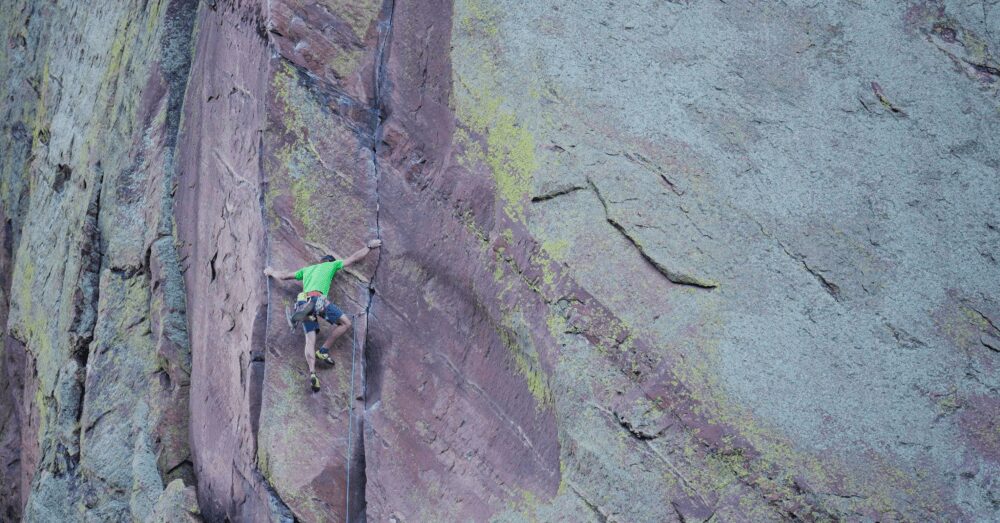
On Sunday, April 12, 2026, at about 8:15 p.m., the Boulder County Communications Center got a report of climbers needing help on the Naked Edge route in Eldorado Canyon State Park. The group said they couldn’t continue their ascent after losing their way and realizing they had no headlamps as darkness fell. The lead climber was on pitch five, while the other two were stuck on pitch four.
The party ran into rope management and pacing issues, which left them stranded after nightfall. Rocky Mountain Rescue Group responded to the technical rescue, and Boulder Emergency Squad helped with drone support. Rescuers kept visual contact with one of the lower climbers using the drone while others worked toward the lead climber.
Rescuers reached the first climber around 10:30 p.m. and handed over warming supplies. A rescuer then rappelled about 105 feet to the two lower climbers, securing them at roughly 11:31 p.m. Those two were helped up the final pitch, and the technical portion wrapped at 12:58 a.m. All three climbers made it back to the trailhead by about 2:25 a.m.
Route Prep Starts Long Before You Tie In
The Naked Edge is no place to wing it. Its five pitches include a 5.11a finger crack, a 5.10b arête sequence, a 5.8 reprieve, the notorious 5.11b bombay chimney, and a 5.11a boulder problem pitch that ends in a steep hand crack. Most climbers call the fourth pitch the crux. Others say the start of the fifth is just as hard. Stack a punishing chimney and a powerful boulder problem on top of three pitches of finger and arête climbing, and even strong parties can get spit out late.
Bailing isn’t simple either. Only pitches one, two, and four have bolted anchors. The rest rely on gear, pitons, or slung blocks. Pitch three is 34 meters long, so rappelling with a 70-meter rope would be a rope stretcher, and building a gear anchor midway carries real risk on chossy rock. Some parties can get down from the top of pitch three if they’re careful, but pitch one is the realistic turnaround for most people. If you can’t comfortably onsight pitches one and two, you’re committing yourself to either topping out or asking for help.
Pick warm-up routes that test the same skills. Vertigo (5.11b) and Yellow Spur (5.9+) are Eldo classics that prep climbers for the Naked Edge. Vertigo is only three pitches but forces you to figure out a tricky descent. The Yellow Spur is much easier but a long, somewhat committing route that shares a descent with the Naked Edge, so climbers can get familiar with the way down.
The Gear That Could Have Changed the Story
Forget the shirtless detail for a second. The real gear failure was the headlamp. All three men were shirtless, and one reason they needed outside help was that none had headlamps or layers ready for Front Range temperatures, which can drop from 80 to 30 degrees after the sun sets in April.
Pack a headlamp with fresh batteries on every multi-pitch, even short ones. Throw in a wind shell, a snack bar, and a small water bottle. The whole kit weighs almost nothing and lives in the bottom of your pack. As Boulder County officials said after the call, climbers on long routes need to manage their time and finish their objective well before dark.
Self-Rescue Skills Are Non-Negotiable
Strong climbing alone won’t save you when something goes sideways. More important than climbing skill is self-rescue knowledge, and rescue teams are seeing fewer people prepared to handle problems on their own outdoors.
Before you commit to a route like the Naked Edge, you should be able to escape a belay, ascend a rope with friction hitches, build a quick rappel anchor, and lower a partner past a stuck spot. Practice these at the crag in daylight when nothing is on the line. The first time you tie a Munter mule shouldn’t be at 9 p.m. on pitch four.
Honest Checklist Before You Commit
Are you actually ready for a committing multi-pitch? Be honest. You can climb the crux grade clean on gear. Your partner moves at the same pace. You’ve timed yourselves on similar routes. You’ve practiced self-rescue in the past month. You carry a headlamp, layers, food, and water by reflex, not as an afterthought. You know your bail points and the descent walk-off cold. If any of those feel shaky, pick a smaller objective and build up. Every emergency call pulls volunteer rescuers from their families and sleep, so it’s worth pulling every lesson we can from this one.