
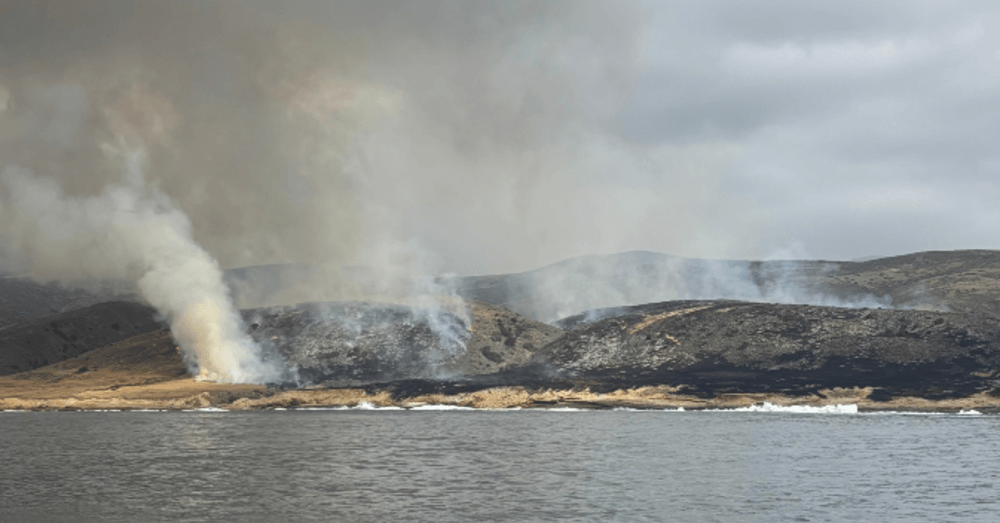
A rescue gone sideways has turned into a full-blown ecological crisis off the Southern California coast. After a 67-year-old sailor crashed his boat on a remote stretch of Santa Rosa Island and fired emergency flares to draw help, the sparks landed in dry brush and lit up one of the most fragile landscapes on the West Coast.
- The blaze has grown past 14,000 acres with zero containment as of mid-May 2026.
- Santa Rosa Island is closed to visitors, and 11 park staff were evacuated by helicopter.
- Crews are racing to protect rare Torrey pines, island foxes, and Chumash archaeological sites.
How a Rescue Call Became a Wildfire
The first report came at about 4:42 a.m. on Friday, May 15, 2026. Park staff confirmed the fire by about 8:30 a.m., and the Coast Guard rescued the sailor at about 10:38 a.m. before flying him to Camarillo for evaluation. The fire started after a 67-year-old sailor wrecked his boat along the island’s rocky shoreline. Stranded overnight, he fired emergency flares in hopes of being spotted by passing vessels.
Two good Samaritans in their own boats reported to the National Park Service that they saw a vessel aground in pieces, said Kenneth Wiese, a Coast Guard spokesman. On Saturday, the Coast Guard rescued the 67-year-old man, who was not injured. By then, the brush around the wreck site was already burning out of control.
A Fire That Outran Firefighters
The growth curve has been ugly. The sailor was rescued on May 15, but the wildfire had already grown to 1,000 acres by that afternoon. Just 24 hours later, the fire was nearing 7,000 acres, and by Monday afternoon it covered more than 10,000 acres on the southeastern section of the island. By Monday evening, the burn area had climbed past 14,500 acres. Still uncontained on Monday night (May 18, 2026), the blaze has become the largest wildfire in California so far this year and the biggest recorded on Santa Rosa Island in modern times.
Conditions have made suppression nearly impossible. More than 70 firefighters have been assigned to the incident. Crews have focused on protecting housing areas, the pier, historic ranch structures, and the island’s rare Torrey pine groves. Wind gusts above 30 mph repeatedly disrupted aerial water drops, with one firefighter reporting gusts reaching about 50 mph. Equipment had to be ferried in by boat because choppers couldn’t reliably drop water from above.
What’s at Stake for Wildlife and History
Santa Rosa isn’t your average island. The Channel Islands are often compared to the Galapagos because of the number of species found nowhere else. Santa Rosa alone is home to six endemic plant species, along with island foxes, island spotted skunks, and rare seabirds.
The biggest single concern is a tree most Americans have never heard of. Torrey pines grow naturally only on Santa Rosa Island and in a small reserve near San Diego. By Monday night, officials said the fire had reached the Torrey pine habitat on the island’s eastern side. Early assessments suggested the flames moved through the area at low intensity and that the grove was still standing, though crews had not yet completed a full inspection.
The cultural losses could matter just as much. For thousands of years, the Chumash People lived on the islands, and Santa Rosa holds many important archaeological sites. The island “contains thousands of significant and federally protected archeological sites. Archeological investigations on the island have enabled scientists to construct a more complete picture of Chumash life on the islands,” the NPS explained. Two uninhabited historic structures have already been destroyed.
If You Were Planning a Visit
For now, Santa Rosa is off-limits. The island is closed to visitors, and all non-fire-related staff were evacuated Sunday by boat. The other four islands in the park remain open, but travelers should check the National Park Service site before booking concession boats out of Ventura. Whether you’re driving down Highway 101 or flying in from somewhere far less coastal, like Harrisonburg, VA, expect itinerary changes through the summer.
Channel Islands National Park is a string of five islands about 30 miles off the coast of Santa Barbara, California. The park drew over 227,000 visitors in 2025. Santa Rosa is the second-largest island in the park and shelters six plants found nowhere else on Earth. Pier and bridge infrastructure are top firefighting priorities because losing them could lock the public out of the island long after the flames die down.
The Takeaway for Boaters and Park Lovers
This fire is a sharp reminder that distress flares, while life-saving, are still pyrotechnics aimed at dry vegetation. Park records note that strong winds are part of the island’s reality year-round, with 30-knot gusts not uncommon. In an isolated landscape like this one, a single flare can become a national conservation emergency in minutes. If you sail the Channel, carry electronic visual distress signals and a registered EPIRB alongside traditional flares. The next stranded mariner who reaches for a pyro flare on a windy bluff could do even more damage to a place that genuinely can’t be replaced.